

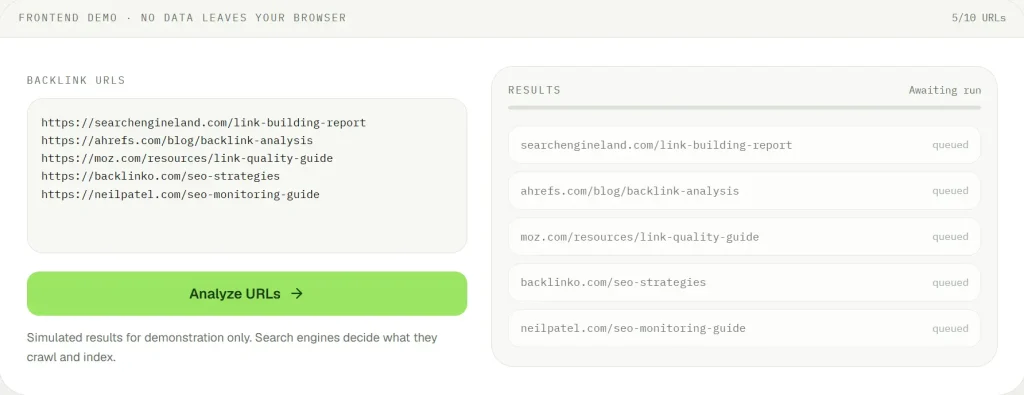
Submit URLs
Paste backlink URLs individually or upload a CSV list

Backlink Verification
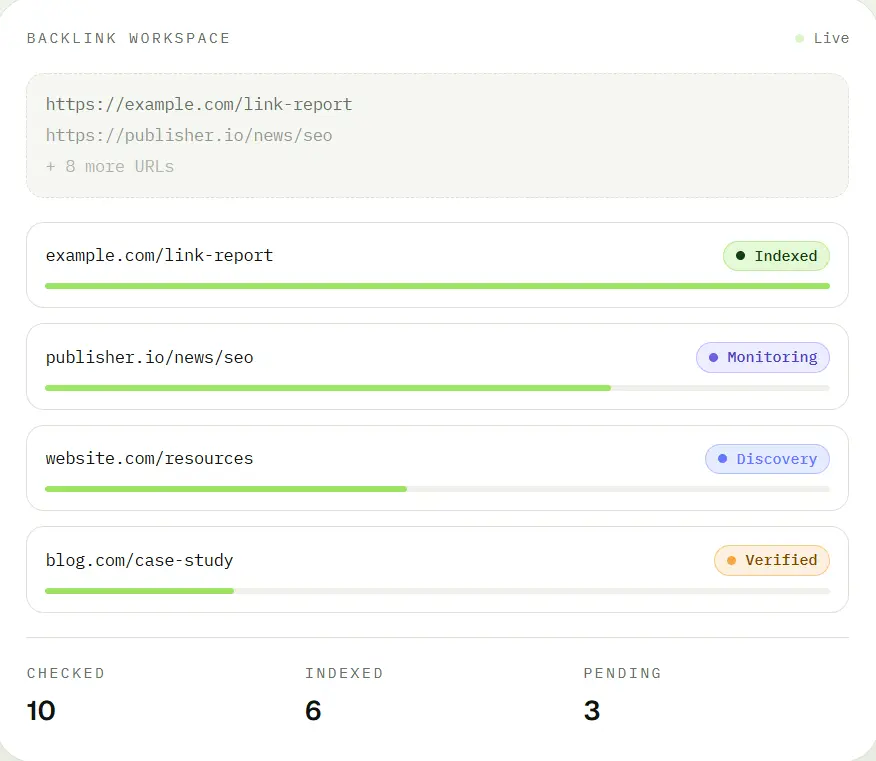
Each page is fetched and the expected link is checked in place.

Discovery Processing
Eligible pages are prepared as discovery signals and queued.

Monitoring
Status moves through pending, discovered, crawled and indexed.

Issue Detection
Blocking factors are surfaced with the exact signal that caused them.

Indexed
Confirmed pages are tracked so regressions are caught early.

Index Signals
Notes robots, noindex, and meta directives that affect indexing.

Redirect Detection
Follows redirect hops and reports the final destination.

Discovery Queue
Prepares eligible pages as discovery signals in a managed queue.

Status Tracking
Keeps a timeline of every status change per URL.

Placement Verification
Confirms the expected link is present in the live page HTML.

Anchor Text
Records the exact anchor text used for each placement.

Canonical Detection
Reads the canonical target and flags pages pointing elsewhere.

HTTP Status
Captures the response code returned by the backlink page

Monitoring Schedule
Rechecks URLs on a recurring cadence based on your plan.

Reporting
Exports the current state of any project as CSV.

URL
A backlink page enters the workspace.

Verification
Placement, anchor and attributes confirmed.

Discovery
Signals prepared for eligible pages.

Monitoring
Recurring rechecks track every change.

Indexed
Index status recorded with a timestamp.

Backlink Removed
The page still loads, but the link you paid for is no longer in the HTML.

Redirect Chain
Multiple hops between the link and its destination dilute and delay crawling.

Blocked by Robots
A robots.txt rule prevents the page from being crawled at all.

Canonical Issues
The page declares a different canonical URL, so credit is attributed elsewhere.

No Crawl Signals
Nothing links to the page internally, so crawlers rarely reach it.

Low Authority Page
Thin or orphaned pages are crawled infrequently and often stay unindexed.

Save Hours
One run replaces manual site: searches, source inspection and spreadsheet updates.

Know What Changed
Removed links, new redirects and canonical switches are recorded as status events.

Track Everything
Group URLs by client or campaign and export the full state whenever you need it.